
Wayback Machine Links Only
5 essential artist/producer interviews that deserve preservation.
If you want to support Micro-Chop you can follow me on Spotify and subscribe to the newsletter and YouTube channel.
If you follow music journalism, you’re probably aware that the current state of the industry isn’t awesome. As always, great writers are doing great work, but a string of mass layoffs in recent years and a shrinking pool of existing outlets have created a pretty bleak reality for the modern-day music writer.
I have some more thoughts on this that I’d like to share in a future post. For now, I'm sharing articles I’ve bookmarked over the years from outlets that have either deleted or limited access to their archives, making them unavailable except through the Internet Archive’s Wayback Machine.
These articles deserve attention and preservation because they contain important information (sometimes only available through these specific pieces) about artists who helped shape the sound of electronic/experimental/rap/sample-based music. I thought the information in these articles would be interesting to Micro-Chop readers.
I’ve bookmarked hundreds of stories since starting Micro-Chop in 2016. Unfortunately, the links to far too many are now dead. If a more extensive list of archived articles is of interest to you, please let me know in the comments.
I’ve also linked to the journalists cited here where possible so you can check out their more recent work. I was unable to find anything for Paul Arnold, who was a prolific writer for HipHopDX and other rap outlets for many years.
“The Enduring Legacy of J Dilla” by Bill Murphy via Electronic Musician (2006)
Notable quote: “I remember MC Silk was his rap name when I met him…He would come and pick us up in the Escort and play these beats from the song ‘Louie Louie’ that he had sampled on two tape decks. And I watched how he went from those pause-and-record mixes all the way to the [Ensoniq] ASR-10, the [E-mu] SP-1200 and the [Akai] MPC, you know? As I watched him grow, he just became the greatest producer.” - Baatin (R.I.P.) of Slum Village
“Easy Mo Bee Traces Ice Cube & Big Daddy Kane’s Influence On Biggie’s ‘Ready To Die’” by Dana Scott via HipHopDX (2014)
Notable quote: “There’s a bassline in the original version. Go back and listen to that record. I played the bassline live all the way through that record from the SP-1200 through multi-pitch. It was like a bass guitar strumming, and if I messed up, it was like ‘Yo bring it back, and plug me in’…I played the bass all the way through the record. I used to do interesting things like that. I used to tell my engineer, ‘Just bring me back and punch me in.’ I knew that 2Pac was big on the funk and valued that whole playas thing. So I wanted to create something loose.” - Easy Mo Bee
“TIMELESS: DJ Premier Revisits Gang Starr’s ‘Step In The Arena’” by Paul Arnold via HipHopDX (2011)
Notable quote: “Because, for one I didn’t have any equipment yet, when we lived in the Bronx. And I had two copies of that [record], so to cut that up – And that was during the Public Enemy era, where it was all about noise and screaming and wailing horns and just [trying to] sound like we’re rioting or just fighting for respect and freedom. That’s what it was. I just wanted to do my interpretation of that.” - DJ Premier
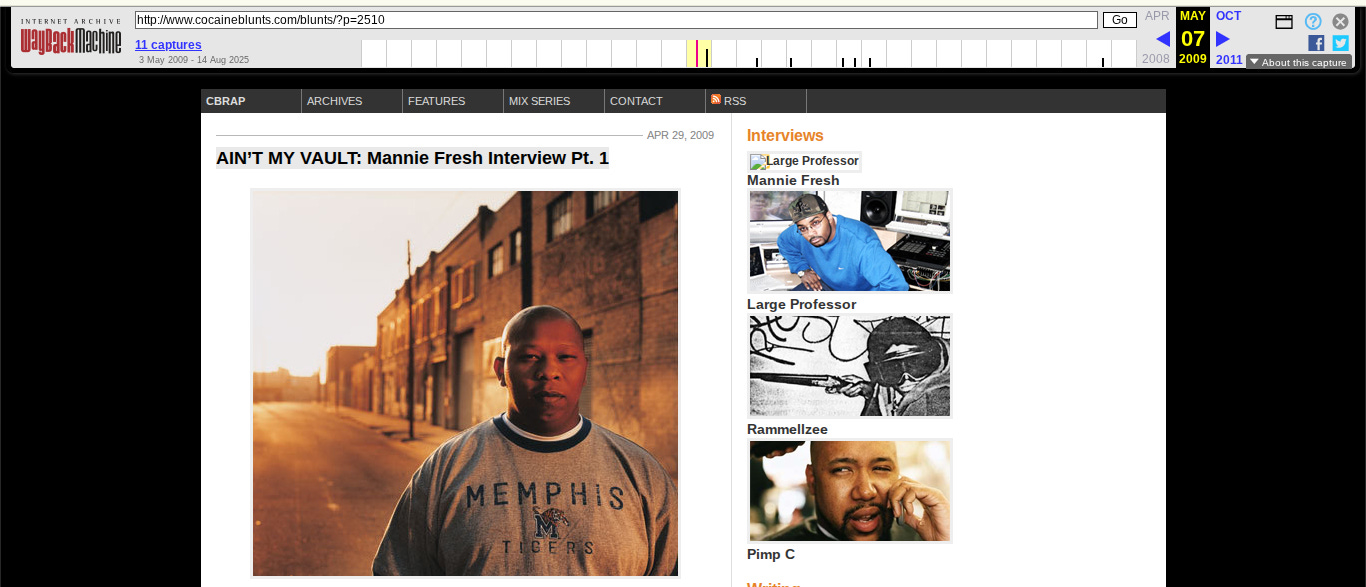
“RIP Pimp C - Interview Part 1, Part 2, and Part 3” by Andrew “Noz” Nosnitsky via Cocaine Blunts (Conducted in 2006, published in 2007)
Notable quote: “I come from the era where we used to make pause mixtapes. Two tape decks and pause the tape and back up the break and make it play again. I can remember the time when we had drum machines, but samplers hadn’t come far enough for us to be able to afford one. So instead of using samplers, we had a four-track recorder, my DJ, DJ DMD, he was good with his turntables. He would catch the break, but a lot of times we wouldn’t have but one of the records that we was trying to catch the break from, so what he would do was that the drums would be on track one of the four track, he’d play the break for however many bars it’d play, then he’d hit the crossfader, stop it, and hold out for another four bars or whatever what the break went, then he would come back on track two and lay it out again where he left the space. So track two and three was his loop. After that he would take tracks two and three and bounce both of them to four, combine two and three so it played as a loop. That’s how we had to do samples.” - Pimp C
“Phonte, Big Pooh & 9th Wonder Remember ‘The Minstrel Show’ 10 Years Later” by Jerry L. Barrow via WatchLOUD.com and Nodfactor (Published in 2015, republished in 2017)
Notable quote: “Phonte wrote a letter to everybody that we sampled on the behalf of all of us. He explained what the song was about it and why we chose their song. And we got some great feedback from that. We actually cared about the music we used. I thought it was a brilliant idea.” - 9th Wonder
i really appreciate this list and would love a more extensive version! grateful for the work you do